F-19: WHEN MICROPROSE ALMOST UNVEILED THE FUTURE

The premise of F-19 is much different from that of most flight simulators and also deceptively simple: Fly to the objectives, accomplish your mission, and fly back to base .. undetected. This last word epitomizes not only the nature of the game, but also years of secret aerospace engineering research. The development and deployment of working air radar at the late 1930s, beginning with the UK’s Chain Home system, meant that aircrafts no longer could approach targets undetected. (Fun fact: Radar is not a word, but actually a technical acronym: RAdio Detection And Ranging.) During WWII and later during the Cold War everyone was looking for ways to make aircraft invisible to radar or at least less observable. The development of the stealth fighter as we know it today which began in the late 1960s by accident, after British Avro Vulcan strategic bombers under certain conditions were disappearing from RAF’s radars, only to reappear moments later. This was not some sort of an early Philadelphia experiment, but instead a direct consequence of the reduced radar cross-section (RCS) of the Vulcan’s airframe which resembles a flying wing. As this was designed with better aerodynamic performance in mind and not stealth, it can be said that in this case the bug became feature, so to speak.
So if Vulcan looks like a a flying wing, how did F-19’s bell shape (looking from above) in the game came to be? It comes from the Testors 1/48 model kit of F-19 released in 1986 which is credited in the introduction screen. Testors seem to have based their model partly on SR-71 Blackbird, coincidentally officially retired the year F-19 was released. Also, it should be noted that there are other F-19 model kits like those from Monogram (1/48 kit made in 1987), Revell (1/144 kit made in 1988), and Italeri (1/72 kit made in 1987, new box in 1991). Furthermore, there is the fictional Loral sales poster where the F-19 has an airframe resembling that of a modified X-29. The reason there already were many fictional representations of F-19 is that by 1988 there was heavy speculation about the existence of a secret stealth fighter, fueled by a gap at the Tri-service fighter aircraft designation sequence. In 1988 the urban legend of F-19 came to an end when USAF revealed the now retired F-117 to the world.
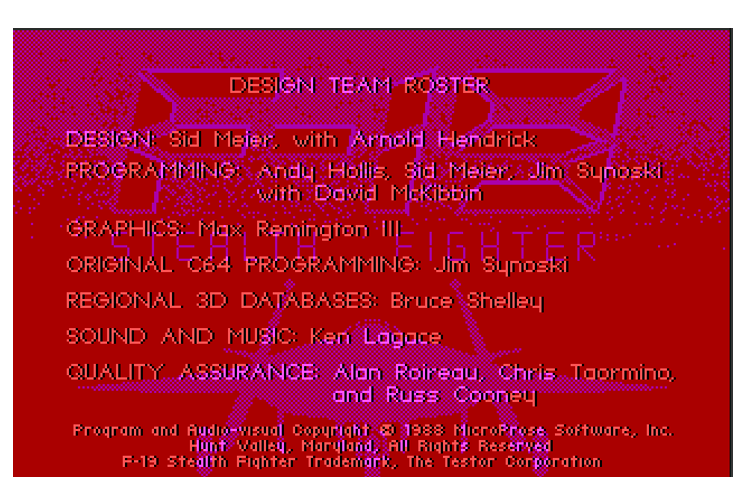
The reference to Testors model can be seen in the credits screen.
That year Microprose released F-19. Actually, the company had delayed the announcement of the game from September 30th to November 10th, the very same day USAF publicly and officially acknowledged the existence of F-117. This was not planned, giving rise to an incredible coincidence which piqued the public’s interest and also led to many inevitable comparisons between the fictional and the real stealth fighters. Clearly F-117 did not look like F-19 at all, the former being very angular and having an arrow-like or triangular shape. This is attributed depending on the source to reasons ranging from the limitations of the supercomputers of the era to enhanced aerodynamics performance.
Getting ready for a mission
Once the game loads, there is a copy protection screen with an aircraft identification exam. Some familiarity with Western and Warsaw Pact fighters of the time is all it takes to master it, with MiG-25 and MiG-31 being a tricky pair, the latter being a design having evolved from the former. Moreover, the airframes the player needs to know are in the game manual. A proposito, continuing its tradition of extensive manuals Microprose spared no effort to make it as humanly comprehensive as possible, covering everything from basic aerodynamics to dogfight tactics and a summary of the geopolitical intricacies underpinning the situation of each theater which indirectly but essentially shape your missions. After the exam, the player sees the roster where the available and the unavailable pilots, whether MIA or KIA, are listed. The latter are there so the player can remember past deeds. For each pilot there is a short summary which includes the total career points and the medals, each with its own ribbon. Notice that there is no way to alter a pilot name from within the game, so be careful!
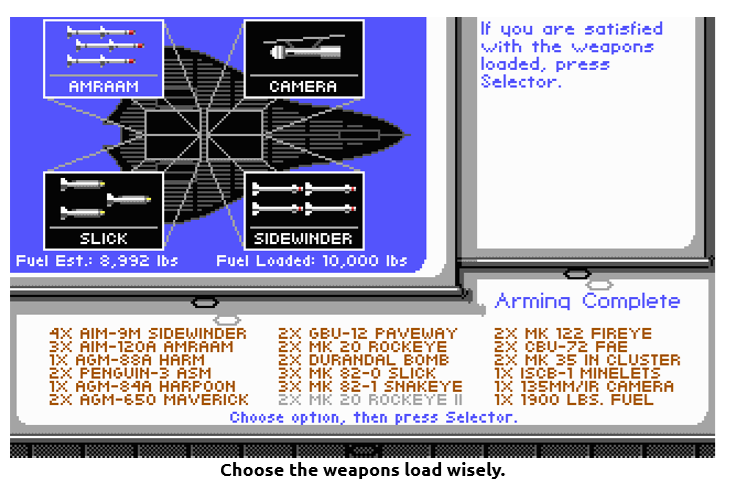
Then it is time for selecting and parameterizing the next mission. Although the mission objectives are completely random, the player can choose the theater, the type of conflict, the opposition level, and the difficulty, if any, of the landing. These factors determine the overall mission difficulty and are also among the ones contributing to the mission score (more about the scoring system later). The type of conflict realistically reflects the political climate of Cold War with multiple references to geopolitical events of that time inserted organically in the game. Moreover, the rules of engagement (RoE) are consistent with the political situation. For instance, under cold war RoE the player is penalized for being seen by enemy aircraft or for being detected by an enemy radar. The four available theaters in increasing level of difficulty are Libya, the Persian Gulf, the North Cape (i.e. the Kola peninsula), and Central Europe. The opposition depends heavily on the theater adding to the realism. For instance, the Iranian skies are defended among others by F-14s as Iran was the only other nation in the world besides the US to have operated the now retired legendary fleet defender, a fact used in the third act of Top Gun: Maverick. Along the same line of reasoning the objectives depend on the theater, so in the North Cape theater the player should expect frequent missions against Krivaks, against one of the countless cargo ships carrying crucial cargo to the port of Murmansk (the only Arctic Russian port open throughout the year), or against the sub pen of Severomorsk, a strategic naval installation referenced also in the iconic 1990 film The Hunt for Red October]. Hint: In-game the sub pen can only be destroyed by FAE bombs and only when these thermobaric weapons are fired to the pen’s doors. Note that there is no campaign mode, so each target hit by the pilot reappears intact in the next mission.
The mission objectives and the weapons selection are closely interrelated, so choose your weapons carefully while keeping an eye on the fuel as well as on the total plane weight as it directly influences fuel consumption. For longer missions it may be wise to skip a load of bombs in favor of an internal fuel tank. During the weapon selection screen the player has an extensive arsenal at their disposal, though some weapons may be randomly unavailable on occasion adding another layer of complexity. Sidewinder (AIM 9) and AMRAAM (AIM 120) are appropriate for air targets, though you may will often have to resort to the M61A1 Vulcan cannon. When it comes to ground targets, said cannon can also be used, but strafing should be done very carefully. However, it is best to use a bomb or a guided missile like the ubiquitous Maverick (AGM 65), which works for most targets. In brief, the most important rule to remember is that not every weapon is suitable for every target and, furthermore, even if the weapon is appropriate the probability of a successful hit varies. The size of the target rectangle is a guide for that with a bigger rectangle indicating a higher hit probability. When the weapon is unsuitable, the on-board computer will plainly refuse to lock on the target, while the target rectangle will be black. Finally, some targets must be approached from the right side in order for the hit to be effective, even though the target rectangle may be indicating a lock. Perhaps the most prominent examples are the aforementioned sub pen, which must be approached by the sea, and the various bridges, which must be targeted from the river bank so that the missiles can lock on one of the bridge pylons.
Flying the aircraft
Once the plane is fueled and armed, you are ready to begin. Taking off is easy as long as you use the flaps and retract the landing gear on time. The strategy is simple: Accomplish the primary and the secondary objective and return home. Use the intuitive controls a low and stealth profile, over water bodies whenever possible to take advantage of radar clutter. Also, flying between mountains and along river banks helps reduce your radar signature for the same reason. A dedicated indicator at the center of the cockpit shows the level of your radar cross-section and, when a enemy radar beam falls on your plane, its relative strength. Be assured that a very dense network of radars, aircrafts, ships, and even infantry and artillery observers is out there and ready for you. Doppler radars are harder to avoid as you have to keep flying straight at them at constant speed, whereas to avoid conventional radars you must fly perpendicular to them. Also, although the over-the-horizon (OTH) radar in Central Europe has been designed to detect intercontinental ballistic missiles (ICBMs), it can still see you. Surprisingly, the top of SAM sites is a relatively safe place as surface-to-air (SA) missiles cannot be fired upwards.
However, this gap can be quickly filled by air-to-air (AA) missiles and even in very close range cannon shells fired by enemy aircraft. Moreover, MiG-29s, Su-27s, and to a lesser extent MiG-31 in addition to being excellent dogfighting aircrafts are equipped with powerful look-down/shoot-down radars allowing them to avoid ground clutter and advanced electronics relaying targeting information to older interceptors like MiG-23 and MiG-25. Thus, whenever one or more of these planes are close to you, you can safely bet more will show up. The same goes for Iranian F-14s which frequently patrol the Persian Gulf, although they are not equipped with deadly AIM-54s. Moreover, the Il-76 Mainstay can accurately see you for a very long distance, fire a handful of AA-10s at you, and also vector fighters to your direction while evading your Sidewinders and AMRAAMs especially if flown by a capable crew. Moreover, destroying the runway of an airbase hosting a squadron of Mainstays will increase your chances of returning home. Still, as F-19 is canonically a subsonic fighter, you have to plan well your ambush to Mainstays, MiG-29s, and Su-27s. While doing so remember that your Vulcan cannon in trained to fire with three seconds delay, meaning that the shells go to where the enemy aircraft will be in three seconds. Thus, the player should not not aim at where the target is now, but instead they should try to guess the actions the enemy pilot will take. Finally, if you are flying too low, beware of missiles from shoulder-mounted launchers, particularly over areas indicated as having excessive enemy concentration. You may be invisible to radars, but not to the human eye!
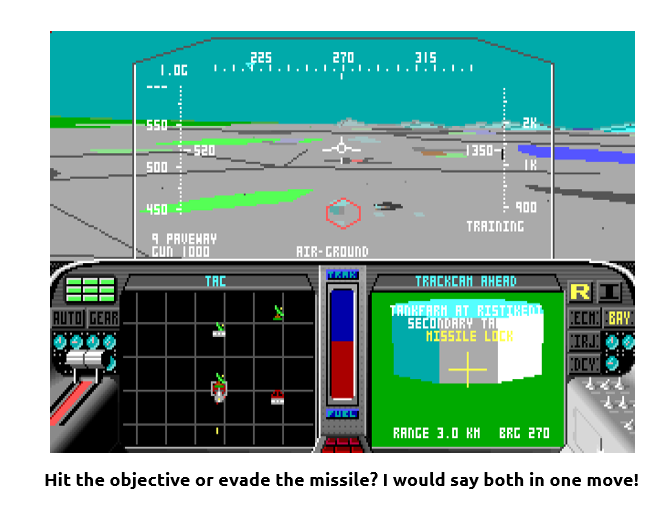
In addition to its stealth design F-19 has a broad spectrum of countermeasures including chaffs, flares, active IR jammers to temporarily blind missile seekers, and three decoys which a signature attracting enemy missiles. As their onboard supplies are limited, all these should strategically used in conjunction with maneuvers as in higher difficulty levels there will be often two or three enemy missiles in the air (Once there were six missiles seeking my plane). So remember to sharply turn your fighter as the more advanced AA and SA missiles have a a wide field of view. F-19 is quite self-aware when it comes to damage control as shown in the panel on the left side of the cockpit. Systems like the fuel tanks, avionics, bay doors, engine are independently damaged, having thus a different effect on the flight. If things get too tough, you can use Alt+T to toggle the training mode on. This is a direct application of the rule that no one ever loses their life in a Sid Meier game.
Landing in higher difficulty levels is difficult, but not impossible. In the unfortunate case where the player has to eject, there are three possible cases, the best one ejecting over water making search and rescue easy while preventing the enemy from recovering the plane. Just remember to eject with the aircraft’s nose pointing slightly upwards to facilitate the bail out. After the conclusion of the mission, regardless of its conclusion, there is a debriefing where the result of the mission and the points won are shown along with comments. The point system is really straightforward when it comes to mission scores: Accomplishing the primary and the secondary objective and successfully landing the plane awards points to the player, while bailing out over hostile land takes some away. However, the algorithm awarding promotions and medals is a totally different story as its takes into consideration the points tallied over a window of recent missions and how it compares to the best mission score that far. As a rule of thumb, in order for the player to be awarded as many medals as possible, they should play at progressively higher difficulty levels to have their best score increase gradually. The ranks are those of the US Air Force with the player starting always as a second lieutenant. Depending on their performance the player can be awarded the Airman’s medal (AM), the Silver Star (SS), the Distinguished flying cross (DFC), the Air Force Cross (AFC), the Purple Heart (PH), and the Congressional Medal of Honor (CMOH). Also, the PH and the CMOH are awarded only once.
Overview
Sid Meier called F-19 “Half an upgrade, half a sequel” referring to the original C64 game Project Stealth Fighter by Arnlod Hendrick and Andy Hollis from 1986 as the PC version turned out to be vastly upgraded. Soon after being a huge success F-19 was ported to Amiga and Atari. The immersion of the game is excellent with the game supporting a wide array of sound cards including the high end Roland MT-32 which had only come out a year earlier and was used for semi-professional sound development. Interestingly, the introduction music in the C64 game seems to based either or Dies Irae by Mozart or on a Witches Sabbath by Berlioz, while it is much different in the PC version. The VGA graphics are good, although the capabilities of the then new graphics card are not exploited as much as they would be in F-15 Strike Eagle II a year later. Even for 1988’s constraints, there are many Easter eggs, while the geopolitical references are accurate. On the downside, there is no campaign mode in the sense that a target destroyed in a mission is there again in the next one, leaving a vague sense that your efforts have little or no effort to the overall war effort. Also, the game objective is to complete the 99th mission and then being promoted to Brigadier General, but there are no such hints in the game. Being awarded the CMOH, which is extensively described in the game manual, feels more natural as a game objective and in fact it has been used as a figure of merit among players. Coming from a time where games had multi-year support cycles, it is no surprise that there is an upgrade for the real F-117 skin as well as one adding additional sound card support, plus an unofficial tool for porting maps from F-15 Strike Eagle II. F-19 is featured in a multidemo by Microprose along with F-15 Strike Eagle II, Red Storm Rising, and M1 Tank Platoon. Additionally, in F-117 there is the option of flying the F-19 listed as Microprose model. Outside the universe of Microprose, F-19 is described in the chapter Frisbees of Dreamland in Tom Clancy’s Red storm rising, perhaps as a result of Tom Clancy having met and worked with Sid Meier. Also a complete list of the tropes is shown here. Moreover, F-19 with a black and purple paint scheme in is the alt mode of Whisper, a Micromaster Decepticon who is the leader of the Air Strike Patrol. In conclusion, F-19 is a great game with high playability value with is referenced across multiple media.